
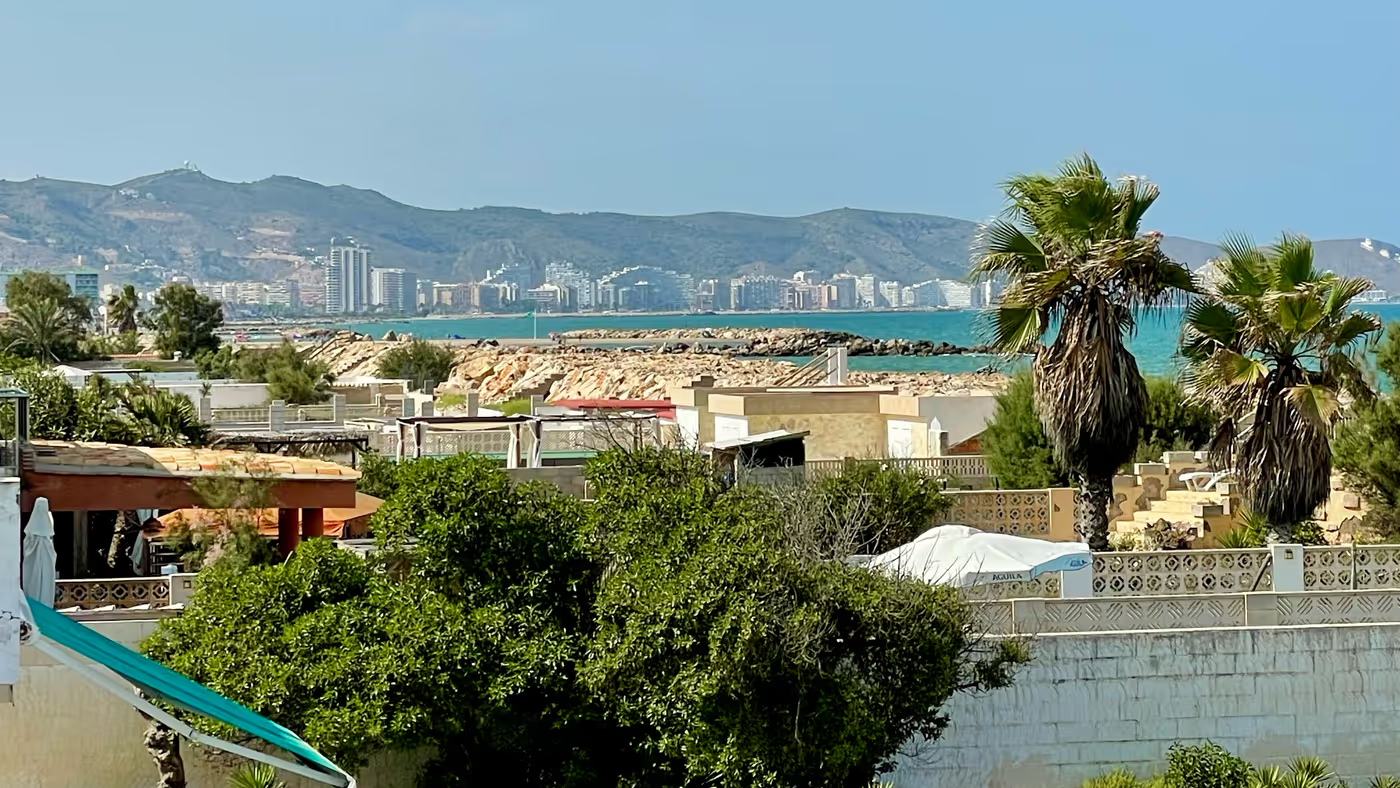
Tavernes de la Valldigna, Gandia, Oliva, Dénia. A house fifty metres from the sand, a price that looks reasonable, and a question almost nobody asks at the right moment: who actually owns the land it stands on?
In Spain, the answer is often: the State. Not the seller. Not you.
This is neither an anomaly nor a trap. It is the regime created by the Ley 22/1988 de Costas, in force for almost forty years, heavily reformed in 2013, and very much back in the news across the Valencia region. Twenty-one boundary-setting procedures are open along the Valencian coast. The Constitutional Court has just upheld the suspension of the regional law that shielded thousands of homes. And in Guardamar del Segura, families live under demolition orders that are now final.
Here is what the law says, precisely, and what it changes when you buy.
The essentials in thirty seconds
- The dominio público marítimo-terrestre (the maritime-terrestrial public domain) belongs to the State. It cannot be bought, and no length of occupation ever turns it into private property.
- Inland of that line runs a protection easement of 100 metres, reduced to 20 metres where the land was classified as urban on 29 July 1988. There you do own the property, but you cannot build freely.
- Inside the public domain, occupation rests solely on an administrative concession with a fixed term (75 years maximum for residential use). When it expires, the buildings revert to the State with no compensation.
- Twenty-one deslinde procedures are under way on the Valencian coast, including Tavernes de la Valldigna, Gandia, Oliva and Dénia. In those municipalities the line has not been drawn yet.
- Three documents to obtain before making any offer: a certificate from the provincial Demarcación de Costas, an up-to-date nota simple, and a municipal certificate on how the plot was classified in 1988.
One thing to know before you read on. Most legal systems have no direct equivalent of the Spanish maritime-terrestrial public domain, and none of the usual reflexes apply. In particular, an entry in the Spanish Land Registry does not give you the protection a registry entry gives you at home: as you will see below, a coastal boundary decision can rectify the Registry, not the other way round.
Contents
- Four zones, four regimes
- 100 metres or 20 metres? The question that changes everything
- Where this is happening in the Valencia region
- How to find out whether a property is affected: five steps
- The concession: what it is and how it is granted
- Does the concession belong to the house or to the owner?
- Can you live in a house with no concession?
- The regional law and its suspension
- What it is worth, in practice, when you buy
- The five most expensive mistakes
- Before you sign
- Frequently asked questions
1. Four zones, four regimes
Everything starts with a line: the deslinde, the official demarcation of the maritime-terrestrial public domain. The central State administration draws it, municipality by municipality, through an adversarial procedure. Every distance is measured from it.
| Zone | Width | What it is | What you can do there |
|---|---|---|---|
| Maritime-terrestrial public domain | As far as the waves reach in the strongest recorded storms | State property. Inalienable, imprescriptible, not subject to seizure | Nothing without a concession. It cannot be bought, nor acquired by adverse possession, however long it has been occupied |
| Transit easement servidumbre de tránsito |
6 m, up to 20 m on difficult terrain | A strip that must stay clear | Pedestrian access and passage for rescue and surveillance vehicles. No obstacles |
| Protection easement servidumbre de protección |
100 m, extendable to 200 m, or 20 m in the cases covered in section 2 | Private land, but heavily restricted | The property stays yours. New residential building is prohibited. Repair, improvement, modernisation and consolidation of lawfully existing buildings are possible, subject to authorisation |
| Zone of influence | 500 m minimum | A planning constraint, not an ownership one | Controlled density, mandatory parking provision, and a ban on «screens» of buildings facing the sea |
The essential distinction is this: inside the protection easement you own a property whose use is restricted; inside the public domain you own nothing at all. You either hold a temporary right of occupation, or you do not.
2. 100 metres or 20 metres? The question that changes everything
This is the most common question, and the answer comes down to one rule and one exception.
The rule: the protection easement is 100 metres measured from the inner limit of the ribera del mar, and can be extended to 200 metres by the administration where coastal protection justifies it.
The exception: it drops to 20 metres for land classified as urban when the law came into force, on 29 July 1988 (third transitional provision). The 2013 reform widened this to settlements that had the characteristics of urban land without formally holding that classification on that date.
What this means in practice: two neighbouring houses, at the same distance from the shore, can fall under two different regimes depending on how their plot was classified in 1988. It is not a question of metres, it is a question of municipal archives. It is also why a seller acting in complete good faith can be genuinely wrong about the regime applying to their own property. Land classification matters elsewhere too, as we explain in our guide to rustic versus urban land in Spain.
3. Where this is happening in the Valencia region
The subject is anything but theoretical. Twenty-one deslinde procedures are under way along the Valencian coast, covering roughly 61 km of shoreline (60,740 metres exactly):
- Province of Valencia: 12 procedures, 30,342 metres
- Province of Castellón: 6 procedures, 16,598 metres
- Province of Alicante: 3 procedures, 13,800 metres, concentrated in Dénia
Only a minority have been definitively approved (four, at the last public count). The rest are spread between the survey stage, the hearing stage and public consultation. In other words, along much of this coast the line has not been drawn yet. It is being drawn right now.
The municipalities involved, from north to south:
- Castellón: Almenara, Moncofa, Nules, Burriana, Almassora, Benicàssim, Oropesa del Mar
- Valencia: Canet d’en Berenguer, Sagunto, El Perelló, El Mareny de Barraquetes, Cullera, Tavernes de la Valldigna, Gandia, Oliva
- Alicante: Dénia, El Campello, Alicante, Elche, Guardamar del Segura, Torrevieja, Torre de la Horadada
South of Cullera, Tavernes de la Valldigna is the most advanced and the most contentious case. Front-line owners on the playa de la Goleta are directly affected; the town hall has filed formal observations and made its legal and technical departments available to them, with the mayor publicly siding with residents. Further south, Gandia and Oliva also fall within the perimeter, and Dénia, with the Les Deveses sector, accounts on its own for every procedure in the province of Alicante.
More than fifty residents’ associations have joined forces across the region under the SOMOS Mediterrània platform. This is not an isolated dispute, it is a groundswell.
4. How to find out whether a property is affected: five steps
No property listing will tell you. Here is the order to follow.
Step 1. The ministry viewer
MITECO publishes an online map viewer of the maritime-terrestrial public domain: sig.miteco.gob.es/dpmt. It shows the deslinde line and the associated easements over more than 10,000 km of coastline. It is free, immediate, and enough to confirm or dismiss a doubt in three minutes.
Step 2. The cadastre
The public domain is also mapped on the Sede Electrónica del Catastro (sedecatastro.gob.es). It can be consulted without a digital certificate, and the interface is available in English. Cross-checking two sources beats trusting one.
Careful: the ministry states explicitly that this data is for information only. It exists to publicise the situation, not to establish a right. A line shown on a viewer is not an administrative act.
Step 3. The nota simple from the Land Registry
Two entries to look for:
- a registered administrative concession: the property is inside the public domain and a right of occupation exists. Note its expiry date.
- an anotación marginal recording that a deslinde procedure has been opened: the law requires this marginal note as soon as the procedure starts. It is the signal that the line may move.
Crucial point: the resolution of a deslinde is sufficient title to rectify any registry entries that contradict it. A Land Registry entry therefore offers no protection against the deslinde. The deslinde corrects the Registry, not the other way round, and this is where buyers from other countries are most often caught out.
Step 4. The provincial Demarcación de Costas
This is the only source with legal force. A certificate issued by the provincial coastal service will tell you whether the property lies in the public domain, in the easement, or outside the perimeter, and whether a procedure is under way. On a front-line purchase this step is not optional.
Step 5. The town hall
It holds the answer to the 100 or 20 metres question: how was the plot classified on 29 July 1988? The cédula urbanística and the planning archives of the period are the evidence.
5. The concession: what it is and how it is granted
If the property sits inside the public domain, private occupation is only possible through an administrative concession. There are two distinct routes, and they should not be confused.
The ordinary concession
For occupying the maritime-terrestrial public domain. It is granted by the Dirección General de la Costa y el Mar of the Ministry for the Ecological Transition, under ministerial delegation, on the basis of a file prepared by the provincial coastal services.
- Who can apply: Spanish or EU nationals; nationals of other countries subject to reciprocity and tax residence in Spain
- File: identification, a basic or detailed project in paper and digital format, an economic and financial study, a provisional deposit, and precise identification of the area to be occupied
- Processing: possible consultation of the town hall, the regional government, the maritime authority and the Ministry of Defence; 20 days of public consultation
- Decision deadline: 6 months. Silence means refusal.
- Maximum term: 75 years
- Consideration: an occupation fee (canon)
- Appeals: an optional appeal to the minister, or a judicial appeal to the Audiencia Nacional within two months
The transitional concession, which covers most older houses
This is the mechanism set out in the first transitional provision for owners whose land was absorbed into the public domain by the 1988 law or by a later deslinde. The principle: ownership is converted into a right of use. You stop owning the land and become the holder of a right of occupation for a fixed term.
- Who: the owner registered in the Land Registry before 1988, or someone who establishes their right in court
- Evidence: registry history proving ownership before 1988, and proof of the uses lawfully in place on 29 July 1988 (building permit, completion certificate)
- Original deadline: one year from the entry into force of the law or from approval of the relevant deslinde. That deadline passed long ago; the administration now handles these files on its own initiative
- Decision: Dirección General de la Costa y el Mar, within a maximum of 6 months, with silence meaning refusal
The terms
The 1988 law provided for 30 years, renewable for another 30. The Ley 2/2013 raised the maximum term to 75 years and opened an extraordinary extension to holders of concessions granted before 2013.
| Use | Maximum term |
|---|---|
| Residential or environmental purpose | 75 years |
| Economic activities, urban services | 50 years |
| Other uses | 30 years |
When to apply for an extension: before the initial concession expires. If the application is filed within the six months preceding expiry, the new term runs from the expiry date rather than from the application date. On a purchase, that detail is worth money.
6. Does the concession belong to the house or to the owner?
Neither exactly, and that is what throws most foreign buyers.
A concession is an administrative right of occupation over an asset in the public domain. It attaches to a specific occupation, the house and its footprint, and it is held by a named holder. It is recorded in the Land Registry. It passes with the property, but never freely:
- Transfer between living parties (sale, gift): it requires prior administrative authorisation. A sale closed without that authorisation leaves you exposed to not obtaining the transfer of the right.
- Transfer on death: heirs must notify the administration within four years. Otherwise the concession lapses.
What to take away as a buyer: you are not buying land, you are buying remaining time. A 75-year concession with 40 years already gone is not worth what freehold is worth, and it is not financed the same way. Banks look at this closely, as we set out in our guide to mortgages for non-residents in Spain.
At expiry, unless extended, the occupation ends and the buildings revert to the State with no compensation. That has been written into the law since 1988 and has never changed.
7. Can you live in a house with no concession?
Yes. Thousands of people do so along the Valencian coast, some of them for three or four generations. But three very different situations need to be separated, because they are not worth the same.
Situation 1. The property is in the protection easement, not in the public domain.
No concession is needed. You are the full legal owner. Your constraints concern what you can build or extend, not your title. This is the most common case and by far the most comfortable.
Situation 2. The property is in the public domain and holds a valid concession.
Your occupation is lawful until expiry. The real subject becomes the remaining term and the extension strategy.
Situation 3. The property is in the public domain with no concession, or with an expired one.
You are occupying without title. In practical terms people do live there: in many stretches, and particularly south of Valencia, the administration has not intervened for decades. But an absence of intervention is not an acquired right. The public domain is imprescriptible: no length of occupation, however long, brings it into your estate. The State keeps the power to open a recovery procedure, and nothing obliges it to justify when it does so.
Two facts on this point deserve to be known before signing.
In Guardamar del Segura, the settlement of Babilonia comprises close to a hundred houses, some of them a century old, built under a concession regime that has now expired. They are subject to demolition orders upheld by the Audiencia Nacional and then by the Supreme Court. The State’s argument: expired concessions and environmental protection of the dune belt.
And in August 2026 the Constitutional Court upheld the suspension of article 17 of the regional law which, since May 2025, had been blocking those demolitions. The procedures the regional government had frozen can now resume.
The honest formulation is this: you can live in a house without a concession, provided you know that you live there by tolerance and not by right, and accept that nobody guarantees that tolerance.
8. The development that changes the picture: the regional law and its suspension
The current standoff is worth understanding, because it determines what happens over the coming months.
May 2025. The Valencian regional government passes Ley 3/2025 of 22 May, on the protection and planning of the Valencian coast. Its article 17 allows certain residential settlements to be declared of special ethnological value and placed under a special protection regime, blocking the demolitions ordered by the State. The law also replaces the framework of PATIVEL, the 2018 territorial plan that protected more than 7,500 hectares of undeveloped coastal land.
1 March 2026. The Council of Ministers approves a constitutional challenge against several articles of that law, invoking the State’s exclusive competence over the maritime-terrestrial public domain. Filing the challenge automatically suspends the contested provisions.
August 2026. The Constitutional Court upholds the suspension of article 17 and of a final provision, rejecting the arguments of the regional government and parliament. Its ruling, published in the Boletín Oficial del Estado on 17 August 2026, holds that lifting the suspension would cause harm to the maritime-terrestrial public domain that would be difficult to repair. It does, however, validate the provision on the inventory of degraded areas.
Today. The Dirección General de la Costa y el Mar can resume the demolition procedures that had been halted. The Constitutional Court has not yet ruled on the substance, and no date has been set for its final judgment.
For a buyer, the reading is simple: the regional shield that some sellers relied on for reassurance is not operative today. Any presentation of a public-domain property as «protected by the Valencian law» has to be re-read in the light of this suspension.
9. What it is worth, in practice, when you buy
A property affected by the Ley de Costas is not an unsellable property. It is a property whose value is calculated differently.
- In the protection easement, the main effect is a freeze on development potential. You will not build a new house and you will not extend freely. In exchange, neither will your neighbour, and the view stays as it is. On a property that is already built and well located, that is sometimes an asset, provided it has been priced in.
- In the public domain with a concession, the decisive figure is the number of years remaining, read together with the extension regime and the fee. Bank financing is harder, the resale market narrower, and the price must reflect both.
- In the public domain without title, you are not buying a property, you are buying a factual situation. That can be defended at a price that explicitly accepts it. It can never be defended at a freehold price.
- In a municipality with a deslinde in progress (Tavernes de la Valldigna, Gandia, Oliva, Dénia), the line has not been settled. Buying before final approval means buying a variable, and the discount must match that uncertainty.
All of this sits on top of the usual acquisition budget, which we break down in our article on property purchase costs in the Valencia region.
10. The five most expensive mistakes
- Trusting the apparent distance to the beach. Everything is measured from the inner limit of the ribera del mar set by the deslinde, not from the parasols.
- Believing that a Land Registry entry protects you. The deslinde is sufficient title to rectify the Registry. It works in the opposite direction to the one intuition suggests.
- Believing that long occupation creates a right. The public domain is imprescriptible. Fifty years of peaceful occupation do not amount to title.
- Buying a concession without checking the transfer authorisation. Without prior administrative authorisation, the transfer of the right is not secured.
- Treating the regional law as a guarantee. Its article 17 has been suspended since March 2026, and that suspension was confirmed in August 2026.
Before you sign
Three documents, to obtain before making any offer on a front-line property:
- A certificate from the provincial Demarcación de Costas on the property’s situation and on any procedure under way
- An up-to-date nota simple, read specifically to look for a registered concession or an anotación marginal
- A municipal certificate on how the plot was classified on 29 July 1988
Plus a review of the file by a lawyer specialising in coastal administrative law. Whatever you are told at the notary’s office arrives too late in any case: by that stage there is nothing left to negotiate.
Looking at a front-line property between Cullera and Dénia?
We check where a property stands under the Ley de Costas before you make an offer: the deslinde line, any concession, any procedure under way, and how the plot was classified in 1988. A few days of checking that prevents a mistake worth several hundred thousand euros.
Talk to our team in Valencia or see how we support buyers in Spain.
Frequently asked questions
Can you buy a house located in the Spanish maritime-terrestrial public domain?
You do not buy the land, which belongs to the State and cannot be acquired through the passage of time. What changes hands is an administrative concession to occupy it, for a limited term, and its transfer requires prior authorisation from the administration.
Is the protection easement 100 or 20 metres?
It is 100 metres as a general rule, extendable to 200. It drops to 20 metres where the land was classified as urban on 29 July 1988, the date the Ley 22/1988 came into force. The answer lies in the town hall’s planning archives, not on the ground.
How can I check for free whether a property is affected by the Ley de Costas?
The MITECO map viewer (sig.miteco.gob.es/dpmt) and the Sede Electrónica del Catastro both show the deslinde line and the easements. That data is purely informative: only the provincial Demarcación de Costas issues a certificate with legal force.
What happens when a concession expires?
Unless an extension is applied for before expiry, the occupation ends and the buildings revert to the State with no compensation. The maximum term has been 75 years for residential use since the Ley 2/2013.
Which municipalities south of Valencia have a deslinde under way?
On the southern stretch of the Valencian coast, Cullera, Tavernes de la Valldigna, Gandia and Oliva are among the municipalities concerned, along with Dénia in the province of Alicante. Twenty-one procedures are open in total, covering around 61 km of coast.
Can a house without a concession be demolished?
Yes. Occupying the public domain without title is not regularised by time, and the State can open a recovery procedure. The case of Babilonia, in Guardamar del Segura, where demolition orders were upheld all the way to the Supreme Court, shows it concretely.
Note. This article sets out the general framework of the Ley 22/1988 de Costas, its reform by the Ley 2/2013 and the regulation approved by Real Decreto 876/2014, together with the state of the procedures under way in the Valencia region at the date of publication. Every case depends on the applicable deslinde, on the planning classification of the plot and on the property’s registry history. It is not legal advice and does not replace a review of the file by a qualified lawyer.
Sources
- Ley 22/1988, de 28 de julio, de Costas (consolidated text, BOE)
- Ley 2/2013, de 29 de mayo, de protección y uso sostenible del litoral (BOE)
- Ley 3/2025, de 22 de mayo, de protección y ordenación de la costa valenciana (BOE)
- Constitutional Court, suspension upheld (BOE, 17 August 2026)
- MITECO, concession to occupy the maritime-terrestrial public domain
- MITECO, concessions under transitional provisions
- MITECO, deslinde lines and map viewer