
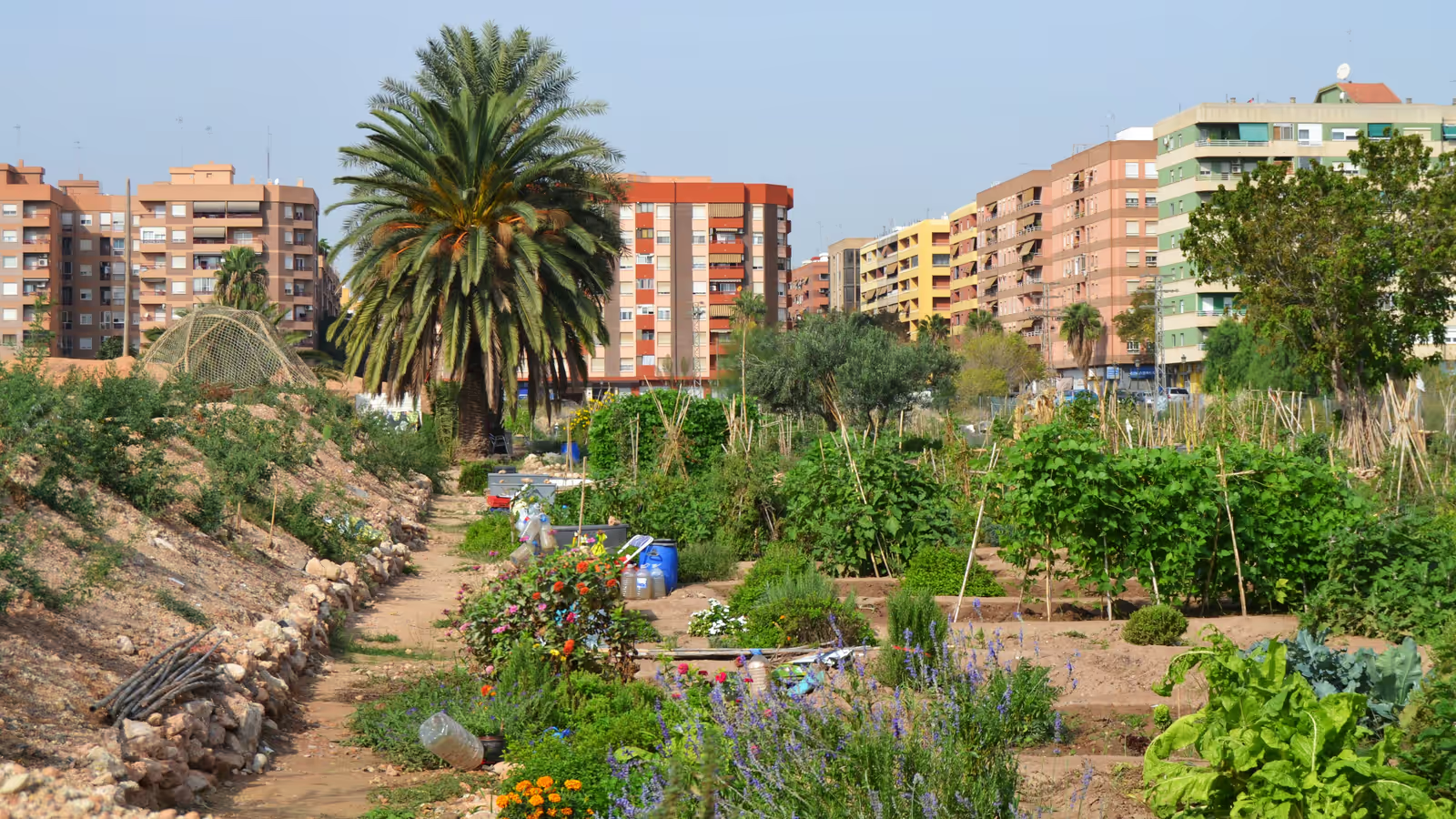
More homes, nearly 70,000 m² of green space and new public facilities: the urban development plan for Benimaclet, in Valencia, has just cleared a decisive stage. Caught between the housing crisis and the protection of the huerta, the farmland that surrounds the city, its approval raises a basic question: how do you build the Valencia of tomorrow without erasing what makes it special? And if you are buying or selling in the neighbourhood, what actually changes for you?
The Benimaclet plan at a glance:
- Approved by Valencia City Council on 23 October 2026, after more than twenty years of debate.
- 268,142 m² between the existing neighbourhood and the Ronda Nord ring road, with 1,345 homes planned, 403 of them subsidised.
- Nearly 70,000 m² of green space and around 32,000 m² for public facilities.
- Next step: the reparcelación, the redrawing of plots. There is no date yet for new residents to move in.
- Residents’ associations object to the loss of around 40,000 m² of working farmland.
A project on the table for over twenty years
On 23 October 2026, Valencia City Council approved the Integrated Action Programme (PAI) for Benimaclet. Located between the current neighbourhood and the Ronda Nord, the project covers 268,142 m² and provides for 1,345 new homes.
The aim is to turn the area into a new urban district with housing, green space, public facilities and new walking and cycling links. On paper, it meets several of the city’s needs: room for new residents, more housing supply and more shared public space.
Its approval did not bring consensus, though. The governing majority, formed by the PP and Vox, backed the project and the opposition groups voted against it. Residents’ associations and groups defending the huerta have also come out against it.
After more than two decades of debate and planning procedures, the project now enters a new phase. And the questions it raises go well beyond Benimaclet.
1,345 homes: an answer to the housing crisis?
It is the headline figure. To understand what it really means, you have to look beyond the total.
Of the 1,345 planned homes, 403 will be vivienda protegida, subsidised housing sold or let at capped prices. The plan also sets aside nearly 20,000 m² of public land for council-owned housing, with an estimated capacity of around 300 affordable rental homes for people under 45.
The distinction matters: those 300 homes are an estimated capacity, not homes that have been built or are available to rent.
So the project mixes several types of housing. But it will not, on its own or any time soon, solve the problem for people looking for a home they can afford in Valencia. One question remains open: how many of these homes will be within reach of those who struggle to find housing today?
Building more can increase supply. But the effect will depend on prices, on the eligibility rules for subsidised and council housing, and on how long construction takes. That is the difference between announcing homes and knowing who will actually live in them. We looked at what is pushing prices up across the city in Valencia property prices: who is driving them up?
More green space, but what happens to the huerta?
The PAI includes nearly 70,000 m² of green space and around 32,000 m² of land for public facilities, including schools, sports grounds and local services.
It also provides walking and cycling routes, extends the pedestrian and cycle link along Avenida de Valladolid to the Ronda Nord and restores historic country lanes. The City Council says the Tello and Bolea houses will be preserved.
These details matter in a neighbourhood whose history is still tied to the farmland around Valencia. And this is exactly where one of the main disagreements lies.
Residents’ associations and huerta campaigners denounce the planned loss of around 40,000 m² of productive farmland. They also question how well the project meets local needs and argue for a different way of planning the area. The City Council, for its part, presents the plan as a chance to create housing, public space and new connections between the neighbourhood and the rest of the city.
The two sides put different things first: expanding housing supply on one hand, preserving more farmland and local identity on the other. The debate is less about how much green space there will be than about what Valencia chooses to keep and what it is willing to transform.
What makes Benimaclet so special?
To understand the reactions, you have to see Benimaclet as more than a stock of building land.
A former village that became part of Valencia in 1878, the neighbourhood has kept a strong local identity, an active community life and historic ties to the huerta. The district has around 28,000 residents and, with the Polytechnic University’s Vera campus next door and the University of Valencia a few minutes away, a large student population. Sitting between the built-up city and the fields, it is especially sensitive to planning decisions.
Transforming this area means far more than putting up buildings. It means deciding how the neighbourhood will connect to the rest of the city, how much room is left for shared spaces and how its character will be respected. The plan keeps some heritage buildings and restores historic lanes, but that has not settled the disagreement over the overall transformation.
The real challenge: how to welcome new residents without turning Benimaclet into an interchangeable neighbourhood, like any other in a big city. The answer will not depend only on the architecture of the new buildings, but also on the quality of public space, the facilities that get built and the room left for neighbourhood life.
Will construction start straight away?
Not necessarily. Approving the PAI is an important step, but it does not mean the homes will be available soon.
The next announced phase is the reparcelación, which sets out how the new plots will be distributed and the development costs attached to them. Building work and the arrival of new residents will then depend on how the procedures and site works progress.
The project allows some infrastructure and building works to run in parallel, provided legal and technical conditions are met. Even so, the homes cannot be occupied until the City Council has formally accepted the infrastructure works.
It would therefore be premature to present the 1,345 homes as an immediate fix for Valencia’s housing shortage. The project sets a direction for the area, but there is still no date for when new residents can move in.
Buying or selling in Benimaclet: what the plan changes, and what it doesn’t
As an estate agency in Valencia, this is the question we have been asked most since the vote. Here is our reading, with no promise of capital growth.
Prices today. According to the Fotocasa index for October 2026, the average asking price in the Benimaclet district is €3,506/m² (−1.2% year on year). That average hides two different markets: €3,830/m² in the historic Benimaclet neighbourhood (+5.9% year on year) and €3,143/m² in Camí de Vera. These are asking prices; actual sale prices are usually a little lower.
If you are selling. The new homes will not reach the market for several years, so the PAI creates no immediate competition for your property. There is no reason to rush, but no reason either to hold out betting on a price rise linked to the project, which remains uncertain. The future park and new links can be presented to buyers as a prospect, with honesty about timing. If you are unsure about timing, our guide Selling my apartment in Valencia will help you decide.
If you are buying. Three things to check before you sign, especially towards the Ronda Nord:
- Distance from the PAI area. A home on the edge will live with several years of building work, then benefit from the park and facilities.
- The view. A listing boasting “views over the huerta” may be looking at land that is due to be built on. The PAI plan will tell you.
- Rental demand. With the universities next door, rentals remain in high demand, worth factoring in if you are buying to let.
If you are buying from abroad, we carry out these checks for you and handle the purchase remotely, from the search to the signing at the notary. To compare Benimaclet with other areas, see also Valencia real estate in 2026, neighbourhood by neighbourhood.
Is building more enough to make a better city?
The approval of the Benimaclet PAI reflects a dilemma Valencia faces: how to meet housing needs without losing its landscapes, its heritage and the character of its neighbourhoods?
Building new homes is part of the answer. But the success of an urban project is not measured only by the number of homes created or the square metres of green space announced. It is also measured by how well the new areas fit into the existing city, the services available to residents, how easy it is to get around and whether real neighbourhood life survives.
The project still has to move from planning to delivery, and its concrete effects cannot be judged yet. But one underlying question is already on the table: Valencia needs to welcome new residents while preserving what makes its neighbourhoods recognisable and pleasant to live in.
The real question is not just how many homes Valencia will build, but what kind of city it wants to build around them.
Frequently asked questions
What is the Benimaclet PAI?
It is the Integrated Action Programme that governs the development of 268,142 m² between the Benimaclet neighbourhood and the Ronda Nord in Valencia. Approved by the City Council on 23 October 2026, it provides for 1,345 homes, nearly 70,000 m² of green space and around 32,000 m² of public facilities.
How many affordable homes does the Benimaclet plan include?
403 of the 1,345 homes will be subsidised housing. The plan also reserves nearly 20,000 m² of public land for council-owned housing, with an estimated capacity of around 300 affordable rental homes for people under 45.
When will the new homes in Benimaclet be ready?
There is no date. The next step is the reparcelación, followed by the infrastructure works. Some building can go ahead in parallel, but the homes can only be occupied once the infrastructure works have been formally accepted.
Does the plan mean the end of Benimaclet’s huerta?
Partly. Residents’ associations denounce the loss of around 40,000 m² of productive farmland. The City Council points to the 70,000 m² of green space, the restored historic lanes and the preservation of the Tello and Bolea houses.
Will the plan push up property prices in Benimaclet?
Nobody can say for sure today. In the short term nothing changes, since no new homes will arrive for several years. In the long term, the park and facilities may make the area more attractive, while 1,345 extra homes will add to supply. In October 2026, the average asking price in the district was €3,506/m² according to Fotocasa.
Planning to buy or sell in Benimaclet? We know the neighbourhood, we follow the plan as it moves forward and we can support you on site or remotely, in English, Spanish and French. Tell us about your project.
Sources: Valencia City Council; Valencia Extra, 23 October 2026; Fotocasa index, October 2026. Information correct as of 27 October 2026.